Rick Owens, Temple of Love: Between Creation and Denunciation
This publication is also available in:  Français
  Deutsch
  Italiano
  Español
  English (US)
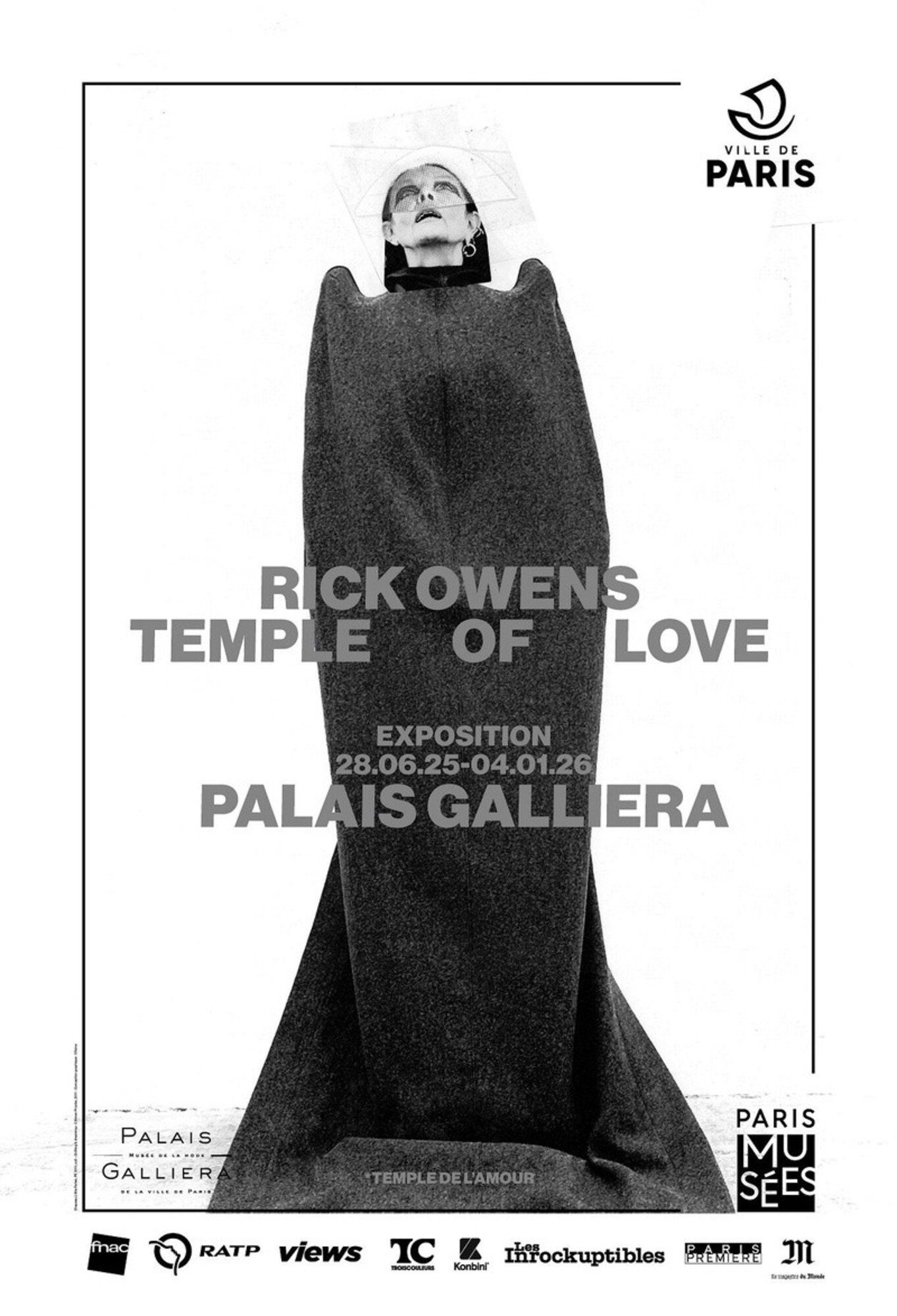
Running until January 4, the exhibition Rick Owens, Temple of Love sheds light on the work of the American designer, blending creative exploration and reflection on the world. Showcasing the graphic silhouettes imagined over the years, the journey emphasizes the symbolism of the collections created by the artist. More than just fashion, his creations serve as both a biographical narrative and a means to denounce the vices of society. A visit that is both personal and spectacular, not to be missed at the end of this year.
Rick Owens, designer of fashion and messages
The exhibition Rick Owens, Temple of Love unfolds through a scenography that is both theatrical and personal, showcasing the vast field of the artist’s creativity. Whether through clothing, furniture, or objects collected over the years, the installation highlights the importance of creation in the artist’s daily life as well as the dialogue between the arts that nourishes his thought.
As the artistic director alongside the Palais Galliera for this first exhibition dedicated to his work, Rick Owens offers us a dive into his mystical and sculptural universe across several rooms, which are complemented by outdoor installations.
Indeed, statues draped in fabrics, flowerbeds inspired by his past, and PONGS sculptures with brutalist lines extend the path of the visit beyond the walls of the fashion museum, which has become, more than ever, a temple of creation in the broadest sense.
From the early ’90s to his more recent creations, the journey of the Rick Owens, Temple of Love exhibition highlights the impact of the artist’s work on the fashion world and our society, oscillating between acts of denunciation and messages of love and tolerance.
Clothing as an autobiographical reflection
Amidst the silhouettes revealing themselves theatrically in alcoves resembling mystical chapels, we discover two studio tables covered with sketches, labels, books, and other photos. Together, these elements present themselves as a biography of the artist, whose diverse experiences, encounters, and experiments have shaped his art and his place in the fashion world.
From the silhouettes presented in the Rick Owens, Temple of Love exhibition, we rediscover how art has shaped the artist’s style, often deemed unconventional and brutalist. Notably, how the image of the sacred and the cinematic, musical, historical, and pictorial references discovered in his youth served as the genesis for pieces unveiled during his future fashion shows.
We observe the evolution of his relationship with clothing, with its materials (recycling work …), its colors (development of his signature “dust” grey), and the ways to structure, wear, and challenge it. Here we rediscover the journey of a creative, whose career began by imitating the work of others, before he established his own label in 1992 and made his mark in the industry.
These are also life trajectories that are reflected in these pieces, where Rick Owens’s tumultuous past serves as a narrative thread in a more peaceful present. From Los Angeles to Paris, passing through Italy, the exhibition reflects a wandering creativity, inspired by places, encounters (including his partner Michèle Lamy), and the various crafts and artisans he has surrounded himself with.
An art to provoke and denounce
Beyond tracing the artist’s creative evolution, the exhibition Rick Owens, Temple of Love emphasizes the importance of clothing as a spokesperson.
“I reject nothing and condemn nothing, I just propose another option” – Rick Owens
Using runway shows as scenes of expression (in line with Wagner’s notion of “total artwork”), the collections and pieces presented carry with them reflections on society and the dysfunctions of our times and its morals.
Initially conceived to provoke, shock, and denounce, these creations have questioned notions of the strange, hypocrisy, racial struggle, women’s rights, climate change, and the dominance of patriarchy. This is true both in their appearance and in the manner of presenting them during fashion shows.
However, over the years, anger has been set aside to envelop the creations with messages of tenderness. Between tributes to the deceased and exploration of the creator’s origins, love has become his new creative engine.
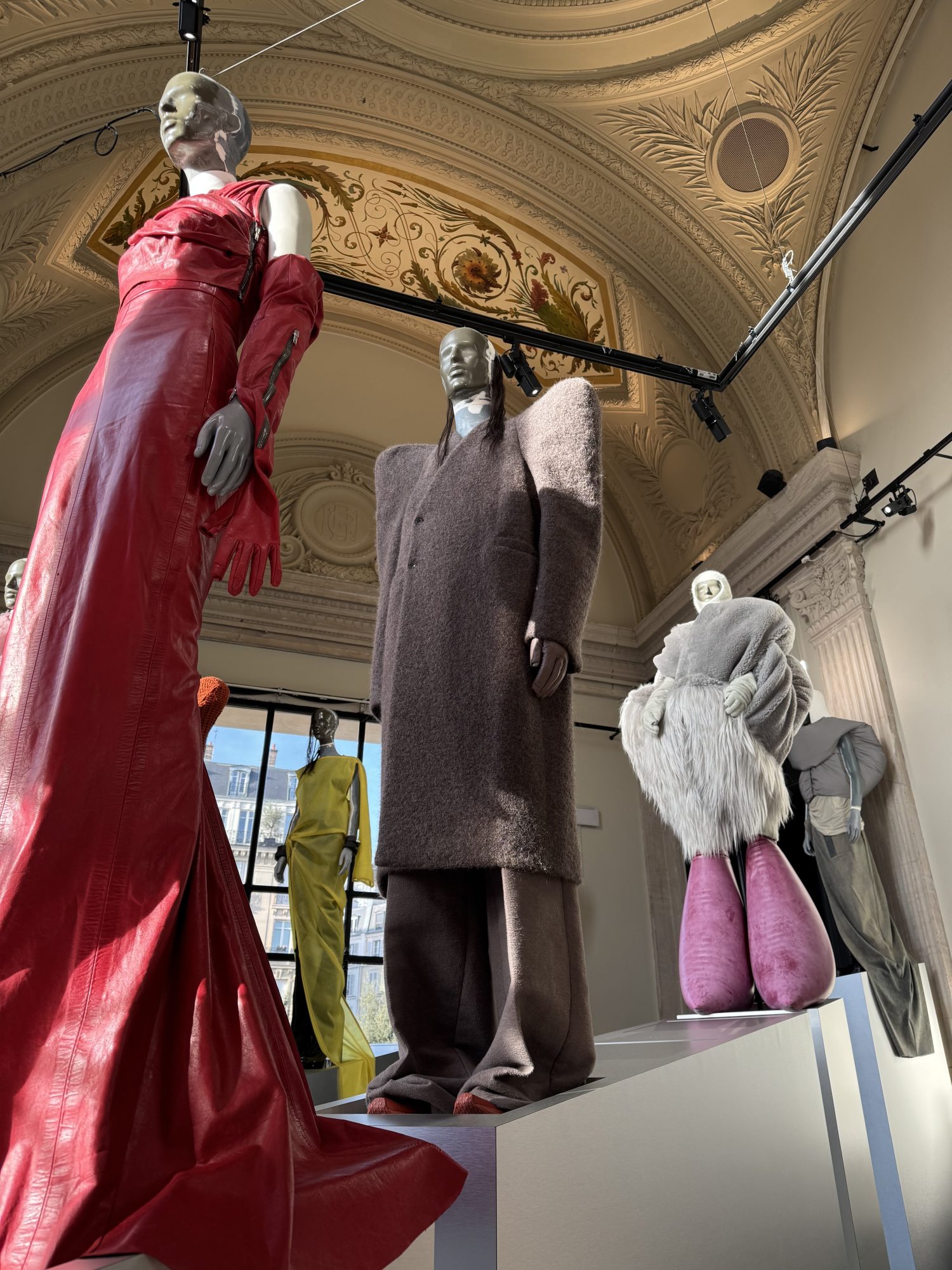
This evolution in symbolism resonates with a new approach to fashion – with silhouettes becoming more colorful and sculptural. This quest for calm and love is illustrated today in the exhibition by three outdoor statues draped in fabrics, Sisters of Mercy, symbols of protection and peace.
Continuing in this spirit of a living and constantly evolving work, a portion of the pieces is displayed in daylight, thus going against conventional conservation rules. This choice integrates the creative process of the artist, who sees possible degradations as a reflection of life’s trials.
Open until January 4, 2026, the exhibition presents itself as a great outing idea for the holidays!
Photos: Palais Galliera